How much does it cost to develop a blockchain app?
Blockchain app development costs range from $30,000 for a basic MVP to $500,000+ for a production-grade DeFi or enterprise application, driven by factors including smart contract complexity, security requirements, compliance, and infrastructure.
Most cost guides focus on headline development spend and miss the compounding costs that grow after launch: infrastructure at $5,000+/month, annual smart contract audits, compliance tooling, and analytics — each requiring separate procurement, integration, and maintenance.
Reown's SDK collapses the authentication, payments, compliance, analytics, and infrastructure layers into a single integration, so growing teams on a Pro or Enterprise plan can access production-grade blockchain tooling without rebuilding each component from scratch.
Building a blockchain app is not like building a typical web application. The cost of getting from idea to production spans smart contract development, security audits, wallet connectivity, compliance infrastructure, user experience work, and ongoing maintenance — each with its own cost profile. Most estimates focus on the upfront development sprint and undercount what comes after.
This guide breaks down the real cost of blockchain app development across every phase: what drives costs, where spend compounds unexpectedly, how costs vary by app type, and how teams building on Reown can reduce total development cost without cutting corners.
Understanding blockchain app development cost
Blockchain app development cost is the total spend required to take an onchain application from concept to production and keep it running — including planning, design, development, security, compliance, infrastructure, and ongoing maintenance.
Unlike traditional software, blockchain apps carry additional cost layers that have no equivalent in web2 development: smart contracts that must be formally audited before deployment, transaction fees that scale with usage, decentralised infrastructure that needs monitoring, and regulatory requirements specific to financial applications. Understanding these layers — and which can be absorbed by existing tooling versus which require custom build — is the most important cost planning decision a blockchain developer makes before writing a line of code.
History of blockchain app development cost
The first generation of blockchain applications, largely Ethereum-based, built from 2015 to 2019, had no established tooling ecosystem. Teams building wallet connectivity, authentication, and payment flows were writing everything from scratch. Development timelines were long, teams were small, and costs were high relative to what was produced.
As the ecosystem matured through 2020 to 2022, infrastructure categories began to consolidate. The emergence of wallet connection standards (WalletConnect), smart contract development frameworks (Hardhat, Foundry), and managed RPC providers significantly reduced the base cost of building on EVM. But the multichain expansion , including Solana, Bitcoin, Tron, and the proliferation of EVM Layer 2s, fragmented the tooling landscape again. Teams adding a second or third chain found themselves re-engineering connection logic, re-testing security surfaces, and re-integrating analytics per network.
The current phase is one of consolidation via SDK-level abstraction. Platforms like Reown handle cross-chain wallet connectivity, authentication, payments, compliance, and analytics in a single integration — changing the cost structure from "build everything, maintain everything" to "configure once, scale across chains." For growing teams, this is the most significant cost lever available.
Why is managing blockchain app development cost important?
Costs compound faster than expected after launch
The most commonly underestimated cost in blockchain development is not the build, it is the ongoing running cost. Infrastructure, maintenance, security monitoring, and compliance updates typically add 15–25% of initial development cost annually. A $100,000 app can cost $20,000 per year to run before any new features are built. Teams that plan only for the initial sprint routinely run out of budget before reaching production scale.
Wrong architecture decisions are expensive to undo
Blockchain applications are harder to refactor than traditional software. Smart contracts deployed to production cannot be modified without a migration (and a re-audit). Authentication flows tied to a specific chain require significant rework to extend to a second ecosystem. Making the right architectural choices, particularly around infrastructure abstraction and multichain support, before starting development is far less expensive than correcting them six months in.
Compliance costs scale with geographic reach
For apps that handle financial transactions, including DeFi, payments and commerce, regulatory requirements add a material cost that varies directly with how many markets you serve. Travel Rule compliance, KYC/AML integration, and user geography tracking are not optional for apps operating at scale. Teams that build compliance infrastructure from scratch, or procure it as a separate service, face both upfront cost and ongoing integration maintenance. This is a line item that is most cost-effectively addressed at the infrastructure layer rather than the application layer.
Infrastructure cost scales with success
High-volume blockchain apps generate high-volume RPC calls, authentication events, wallet sessions, and transaction broadcasts. Each of these has a cost at scale. Teams that start on free-tier or DIY infrastructure frequently encounter unexpected cost cliffs when their app gains traction. Or their app may have usage capped, meaning it simply stops working. This forces teams to either to renegotiate vendor contracts under pressure or to rebuild their infrastructure layer at the worst possible time.
How does blockchain app development cost break down?
Planning and scoping
Before writing any code, teams need a clear scope: which chains to support, what smart contracts are required, what regulatory environment applies, and what the realistic user journey looks like. Rushed or incomplete planning is the single most common cause of cost overruns on blockchain projects.
Typical cost: $5,000–$20,000 for a thorough discovery phase including technical feasibility, compliance assessment, and architecture decisions.
Smart contract development and auditing
Smart contracts are the most expensive component of most blockchain apps relative to their line count. Writing secure smart contracts requires specialist knowledge; testing them requires formal verification tools; and deploying them to production without an independent audit is a security risk that most institutional or DeFi teams will not accept.
Typical development cost: $20,000–$80,000 depending on complexity and number of contracts.
Typical audit cost: $5,000–$50,000 per audit. Complex DeFi protocols requiring multiple auditors can reach $100,000+.
Using well-audited open-source standards (OpenZeppelin) as a base significantly reduces both development time and audit scope.
Wallet connectivity and authentication
Connecting users to their wallets and authenticating them across multiple chains is a non-trivial engineering problem. A single-chain EVM implementation using SIWE can be assembled relatively quickly; supporting EVM, Solana, Bitcoin, and Tron from the same interface — with session management, Travel Rule compliance, and social login options — requires either significant custom development or a dedicated integration layer.
DIY cost: $15,000–$60,000 to build cross-chain authentication from scratch, plus ongoing maintenance per chain added.
With Reown SDK: Authentication is handled via SIWX across all supported chains, with email and social login included. The integration cost is hours, not weeks. And it’s also available on the Starter tier, meaning you can start authenticating users for free!
Payments and transaction infrastructure
In-app payment flows, such as onramps, swaps and exchange deposits, are each a distinct engineering project if built independently. Integrating a fiat onramp requires agreements with payment providers, KYC flow design, and compliance documentation. Building a swap aggregator requires routing logic and liquidity source management. Each of these compounds the total development budget.
DIY cost: $30,000–$120,000 to integrate onramp, swaps, and deposit flows independently across two or three chains.
With Reown Payments : Onramps and swaps are enabled by default within the same SDK integration, even available on the Starter tier (completely free). If you want to enable wallet funding through self-custodial wallets and exchange wallets, you’ll need an Enterprise deal (which starts at $250/month). For more info on Enterprise, check out the Reown pricing page.
Infrastructure and RPC
Running your own blockchain nodes is expensive and operationally intensive. Managed RPC providers are the default for most teams, but at high transaction volumes, per-call pricing can become a material cost. Blockchain API access, needed for reading token balances, transaction history, onchain data, adds further infrastructure requirements.
Typical managed RPC cost: $500–$10,000+/month depending on call volume and chain count.
With Reown Pro/Enterprise: RPC credits are included in the plan at a volume that covers most growing teams, and the Blockchain API handles onchain data reads without additional tooling. Plus, even if you go over the limits for your plan, paid plans aren’t cut off. Instead, you’ll be charged a reasonable price per RPC call over your limit, billed to your account at the end of the month.
Analytics
Understanding how users interact with your app, including which wallets they use, where they drop off, which chains drive volume, requires a data layer. Building bespoke analytics for a multichain app is a significant engineering investment; using a separate analytics tool requires integration work per feature and produces siloed data that doesn't map cleanly to onchain behaviour.
DIY cost: $10,000–$40,000 to build meaningful multichain analytics, plus ongoing engineering to maintain it as features are added.
With Reown Pro/Enterprise: Reown Analytics provides wallet distribution, chain distribution, country distribution, session data, swap volume, onramp activity, and more from the dashboard — available from day one without additional integration.
Security and compliance
Independent security audits of smart contracts are a one-time cost per deployment; ongoing security monitoring, penetration testing, and compliance reviews are recurring. Travel Rule compliance infrastructure — if procured separately — involves vendor selection, integration, and ongoing fees.
Typical security cost: $15,000–$100,000+ annually depending on app complexity and audit scope.
With Reown: The Reown SDK infrastructure has undergone multiple independent security reviews, audits, and penetration tests, reducing the scope of what teams need to audit independently. So, using Reown Authentication and payments solutions means you won’t need to audit those parts. Plus, Travel Rule compliance is included by default for Sign in With X integrations. However, the rest of your code, including your smart contracts and pen testing must still be handled by your team. For Enterprise-grade apps, this is extremely important for your project’s longevity and user trust.
Maintenance and ongoing development
Blockchain apps require continuous maintenance: smart contract monitoring, node health, wallet compatibility updates as new wallets launch, chain upgrades, and compliance changes. This is typically estimated at 15–20% of initial development cost annually.
Typical annual maintenance: $15,000–$60,000 for a mid-complexity blockchain app.
Using an SDK that handles wallet compatibility, chain updates, and compliance infrastructure centrally — as Reown does — reduces the scope of maintenance that falls on the product team.
What kinds of apps have the highest and lowest development costs?
Basic smart contract / token app ($30,000–$70,000)
A straightforward contract deployment, including token issuance, a simple staking mechanism, or an MVP with a single chain and a small set of wallet connections, represents the lower bound of meaningful blockchain development cost. The cost is dominated by smart contract development and a basic audit; infrastructure and compliance costs are minimal at this stage.
Crypto wallet or consumer app ($50,000–$150,000)
A consumer app with multi-wallet support, onboarding flows, and basic transaction capabilities sits in the mid range. The main cost drivers are UX work, wallet connectivity, and the authentication layer. All of these are significantly compressed by using the Reown SDK rather than building each component.
NFT marketplace ($55,000–$180,000)
Marketplace development adds contract complexity (minting, royalties, escrow), payment flow integration, and the UX overhead of a commerce product. Compliance requirements depend on jurisdiction and volume. Reown's payments suite handles the onramp and swap components; the smart contract and marketplace logic remain the primary custom build effort.
DeFi protocol ($100,000–$500,000+)
DeFi is the most expensive category, driven by smart contract complexity, the security standard expected for contracts holding user funds (multiple audits, formal verification), compliance requirements, and the multichain ambition most protocols now have from day one. The infrastructure and tooling layer, such as authentication, payments, analytics and compliance, is where Reown Pro or Enterprise generates the most meaningful cost reduction for DeFi teams. Learn more about Reown for DeFi →
Build vs. SDK: What's the difference for your budget?
The central cost decision for any blockchain developer is what to build and what to integrate. Here is how the two approaches compare across the major cost categories:
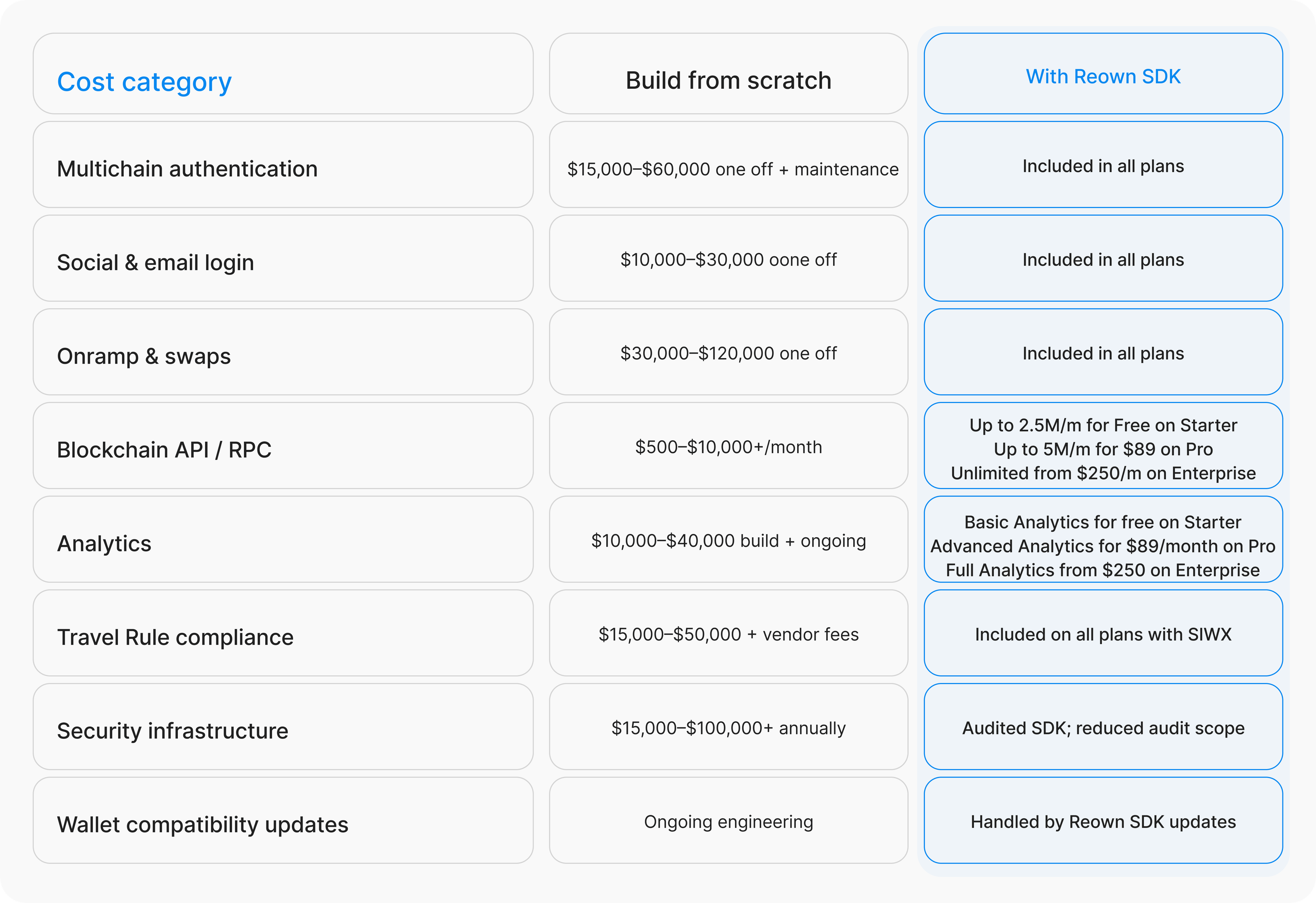
The cumulative cost difference is not marginal — it typically represents $80,000–$300,000 in avoided development spend for a mid-to-large blockchain application, plus significantly reduced ongoing maintenance cost.
Advantages and disadvantages of different approaches to blockchain app cost
Advantages of building from scratch
Full control over every component
Custom-built infrastructure gives teams complete control over behaviour, data format, and vendor relationships. For highly specialised applications with unique requirements — novel consensus mechanisms, proprietary data structures — building custom is sometimes genuinely necessary.
No third-party dependencies
A fully in-house stack has no exposure to changes in third-party pricing, API deprecations, or platform decisions. For teams with the engineering capacity to maintain it, this provides a certain kind of stability.
Disadvantages of building from scratch
Compounding cost and maintenance burden
Every custom component added to the stack is a component that needs to be maintained, updated for wallet compatibility, re-audited when security standards change, and staffed for ongoing support. This compounds quickly for multichain applications.
Slower time to market
Building authentication, payments, analytics, and compliance infrastructure before shipping product features delays the point at which teams can test their core hypothesis with real users. In a fast-moving ecosystem, this matters.
Security risk surface area
Custom authentication and payment flows represent a larger attack surface than audited, widely-deployed SDK infrastructure. Teams that build these components themselves are responsible for auditing them, which adds cost and expertise requirements.
Advantages of building with Reown Pro or Enterprise
Compressed cost across the infrastructure layer
Authentication, payments, analytics, compliance, and blockchain API access are covered in a single plan rather than procured, integrated, and maintained separately.
Production-ready from day one
Reown's infrastructure is audited, stress-tested at scale, and updated continuously for wallet compatibility and chain support. Teams inherit that stability without bearing the cost of producing it.
Scales with your growth
Reown Pro is designed for growing teams that have outgrown the free tier: higher MAU capacity, more RPC credits, and priority support. Reown Enterprise covers teams operating at institutional scale, with custom capacity, dedicated support, SLA guarantees, and compliance tooling suited to regulated financial applications.
How to build a blockchain app cost-effectively
Step 1: Define scope before you write any code
The most expensive thing on a blockchain project is scope creep. Define the chains you will support, the authentication methods users will need, the payment flows required, and the compliance obligations you face — before estimating a budget. Every chain and every feature added mid-build costs significantly more than if it had been planned from the start.
Step 2: Audit your "build vs. integrate" decision per component
For each major infrastructure component — authentication, payments, analytics, compliance, RPC — estimate the cost to build it versus the cost to integrate it via the Reown SDK. The calculation is rarely close: the integration is almost always significantly cheaper, and the ongoing maintenance cost difference is larger still. See the full Reown feature set and pricing →
Step 3: Start with a free-tier integration to validate your core product
The Reown SDK is available on a free tier — create a project in the Reown dashboard, integrate the SDK, and validate your core product before committing to a paid plan. This reduces the risk of investing in infrastructure before you have validated product-market fit.
Step 4: Move to Reown Pro as you scale your user base
When your app has validated traction — growing MAU, real transaction volume, a team managing the product — Reown Pro provides the increased capacity, advanced analytics, and priority support that growing teams need. The step up to Pro is the point at which the platform's compliance tooling, higher RPC credits, and analytics depth become material operational advantages. See what's included in Reown Pro →
Step 5: Plan your smart contract audit budget early
Smart contract audits are non-negotiable for applications holding user funds, and they are easier to budget for when planned from the start than when added under launch pressure. Scope your contracts conservatively, use audited open-source standards as a base, and engage an auditor early. Reown's audited SDK infrastructure reduces the surface area you need to audit yourself.
Step 6: Design for multichain from the first sprint
Adding a second chain to a single-chain architecture costs more than designing for multichain from the start. The Reown SDK supports EVM, Solana, Bitcoin, and Tron from a single configuration — there is no additional cost to enable a new chain beyond adding it to your setup. See supported chains →
The future of blockchain app development cost
The overall direction of blockchain development cost is downward — not because development is getting easier, but because the infrastructure layer is maturing. SDK-level abstraction of authentication, payments, compliance, and analytics means that a two-person team today can ship a production-grade multichain application faster and for less total spend than a ten-person team could in 2020.
The cost ceiling for complex DeFi and enterprise applications remains high — driven by smart contract complexity and security requirements that cannot be abstracted away. But the floor is falling. Teams that build on the right infrastructure layer can reach users across every major blockchain ecosystem, with compliance and analytics in place from day one, for a fraction of what the same product would have cost two years ago.
For most blockchain developers, the question is no longer whether to use an SDK for the infrastructure layer — it is which one, and at what tier.
Explore Reown pricing and get started →
Further reading: