How to develop multichain blockchain apps
Key Takeaways
- Multichain app development is the practice of building onchain applications that operate across multiple distinct blockchain networks from a single, unified integration.
- Without multichain support, apps are limited to a single ecosystem's users and liquidity — making meaningful scale increasingly difficult as the blockchain landscape fragments across EVM, Solana, Bitcoin, Tron, and beyond.
- Reown provides a chain-agnostic SDK that handles authentication, wallet connectivity, and payments across every major network from a single integration, so developers can build for the entire financial internet without rebuilding infrastructure per chain.
Fragmented user bases across multiple networks present one of the most significant challenges for teams trying to scale onchain applications. Users on Ethereum, Solana, and Bitcoin all represent real addressable markets — but serving all three with separate, siloed implementations is expensive, slow, and nearly impossible to maintain at pace.
Multichain app development offers a different approach: build once, reach everywhere. Rather than treating each blockchain as a standalone deployment target, multichain infrastructure treats them as a unified landscape that a single application can serve. Understanding how multichain development works — and which tools make it practical — is one of the most valuable things a builder can know right now.
What is multichain app development?
Multichain app development refers to building applications that can connect to, read from, and write to multiple distinct blockchain networks simultaneously. Rather than scoping an app to a single chain and its native wallets, a multichain app presents users with a consistent interface regardless of which network their assets sit on or which wallet they prefer.
This covers several distinct capabilities: supporting wallet connections from different ecosystems, executing transactions on multiple chains, authenticating users across different network namespaces, and presenting a unified UX that abstracts the underlying chain complexity from the end user.
History of multichain app development
Early blockchain applications were inherently single-chain. The first generation of onchain apps — built on Ethereum from 2015 onwards — assumed users would interact exclusively within the EVM ecosystem. Authentication, payments, and wallet connections were all designed around Ethereum-native tooling.
As adoption grew, so did the ecosystem. Solana launched in 2020, attracting a distinct developer and user community. Bitcoin's Layer 2 ecosystem expanded. New EVM-compatible chains — Polygon, Arbitrum, Base — proliferated. By the early 2020s, a meaningful share of onchain users held assets across multiple chains and expected the apps they used to accommodate that.
The challenge for developers was that each new chain added to an application meant a new authentication library, a new wallet connection implementation, and a new surface area to maintain. The concept of multichain development as a discipline — rather than simply "adding another chain" — emerged from the need to solve this at the infrastructure level rather than the app level.
WalletConnect v2.0, released in 2022, was a landmark moment: it introduced a protocol-level approach to multichain wallet connectivity, allowing a single session to span multiple chains. Reown, built on top of the WalletConnect protocol, turned that protocol capability into a developer-facing SDK that handles the complexity end-to-end.
Why is multichain app development important?
It removes the ceiling on your addressable market
Every chain your app does not support is a segment of users who cannot use it. The EVM ecosystem — Ethereum, Base, Arbitrum, Polygon, and hundreds of other compatible networks — represents the largest single concentration of onchain users. But Solana, Bitcoin, and Tron collectively add tens of millions more. Multichain development removes the ceiling that single-chain architecture places on growth.
It eliminates fragmented liquidity
For DeFi platforms, liquidity siloed on a single chain is a structural disadvantage. Assets on Solana are unavailable to an Ethereum-only protocol; users holding Bitcoin cannot participate in EVM-native yield without bridging first. Multichain infrastructure lets platforms access and route liquidity across ecosystems without forcing users to move assets before they can interact.
It reduces operational overhead as you scale
Each chain added to a single-chain architecture compounds complexity: separate authentication flows, separate wallet libraries, separate testing environments, separate monitoring. Multichain infrastructure — handled at the SDK level rather than the application level — means a team adds a new network by updating a configuration rather than building a new integration from scratch.
It meets users where they are
Users should not have to understand which chain an app is built on, nor be required to bridge assets to participate. Multichain development makes it possible to present a consistent, familiar experience — closer to what users expect from mainstream software — regardless of which network they are connecting from.
How does multichain app development work?
Chain-agnostic authentication
The first component of any multichain app is authentication — proving that a user controls a wallet address. In a single-chain context, this means generating a chain-specific signed message (as SIWE does for EVM). In a multichain context, the authentication standard needs to work across different network namespaces without requiring chain-specific logic per integration.
SIWX (Sign-In with X) is the authentication standard that makes this possible. Built on the CAIP-122 specification, it handles signed message authentication for EVM, Solana, Bitcoin, and Tron from a single implementation. The Reown SDK enables SIWX by default, so multichain authentication is the starting point rather than an add-on.
Wallet discovery and connection management
Different chains use different wallet standards, connection protocols, and session formats. Coordinating wallet discovery across ecosystems — presenting the right wallets for the user's connected network while supporting switching between chains — requires abstraction that most teams cannot build and maintain themselves.
The Reown SDK handles wallet discovery across 500+ wallets, supports multiwallet linking so users can connect multiple wallets from different chains in a single session, and manages connection state across network switches. Users can move between ecosystems within your app without being prompted to reconnect or re-authenticate.
Cross-chain payments and transactions
Multichain apps often need to support transactions across networks — onramps that fund wallets on the user's preferred chain, swaps between assets on different networks, and in-app payments regardless of where the user's liquidity sits. Reown provides onramp, swap, and deposit with exchange tooling that works across all supported chains within the same SDK integration.
Unified analytics across chains
Understanding how users interact with a multichain app requires analytics that can aggregate behaviour across networks. Chain-specific analytics tools produce siloed data — they can tell you what happened on Ethereum but not how that relates to the same user's activity on Solana. Reown Analytics surfaces wallet distribution, chain distribution, country distribution, and transaction volume across all connected chains in a single dashboard.
What kinds of apps use multichain app development?
DeFi platforms
Decentralised exchanges, lending protocols, and yield platforms are among the heaviest users of multichain infrastructure. Morpho, a lending network spanning Ethereum, Base, Unichain, and Katana, uses Reown to support all EVM networks from a single integration and allow users to fund directly from centralised exchange wallets without leaving the app. Multichain support is a direct competitive advantage for DeFi platforms competing for liquidity and user acquisition across ecosystems.
Learn more about Reown for DeFi →
Web3 social apps
Social applications built on Ethereum-based social graphs like Lens Protocol operate in an EVM context but attract users who may connect from different wallet types. Orb, a social platform built on Lens, used the Reown SDK in Flutter to ship a mobile-native multichain experience without building separate wallet connection logic per framework. For social apps, multichain support primarily means reaching users across wallet types and network preferences without requiring them to migrate assets.
Learn more about Reown for social apps →
Blockchain games
Gaming platforms that operate across multiple chains — or need to support both EVM and non-EVM wallets — benefit from multichain infrastructure for both authentication and in-app payments. ZKNoid, a zero-knowledge gaming platform, used Reown to add multiple login methods without interrupting the game experience. In gaming contexts, frictionless onboarding is directly tied to retention, making multichain wallet support a product-critical feature.
Learn more about Reown for gaming →
Marketplaces
NFT marketplaces and onchain commerce platforms that operate across EVM networks use multichain support to let users purchase, swap, and interact with assets without leaving the app to bridge or convert. Multichain infrastructure enables direct funding from centralised exchange wallets — a common entry point for new onchain users — which removes one of the most common friction points in marketplace onboarding.
Learn more about Reown for marketplaces →
Multichain vs single-chain: What's the difference?
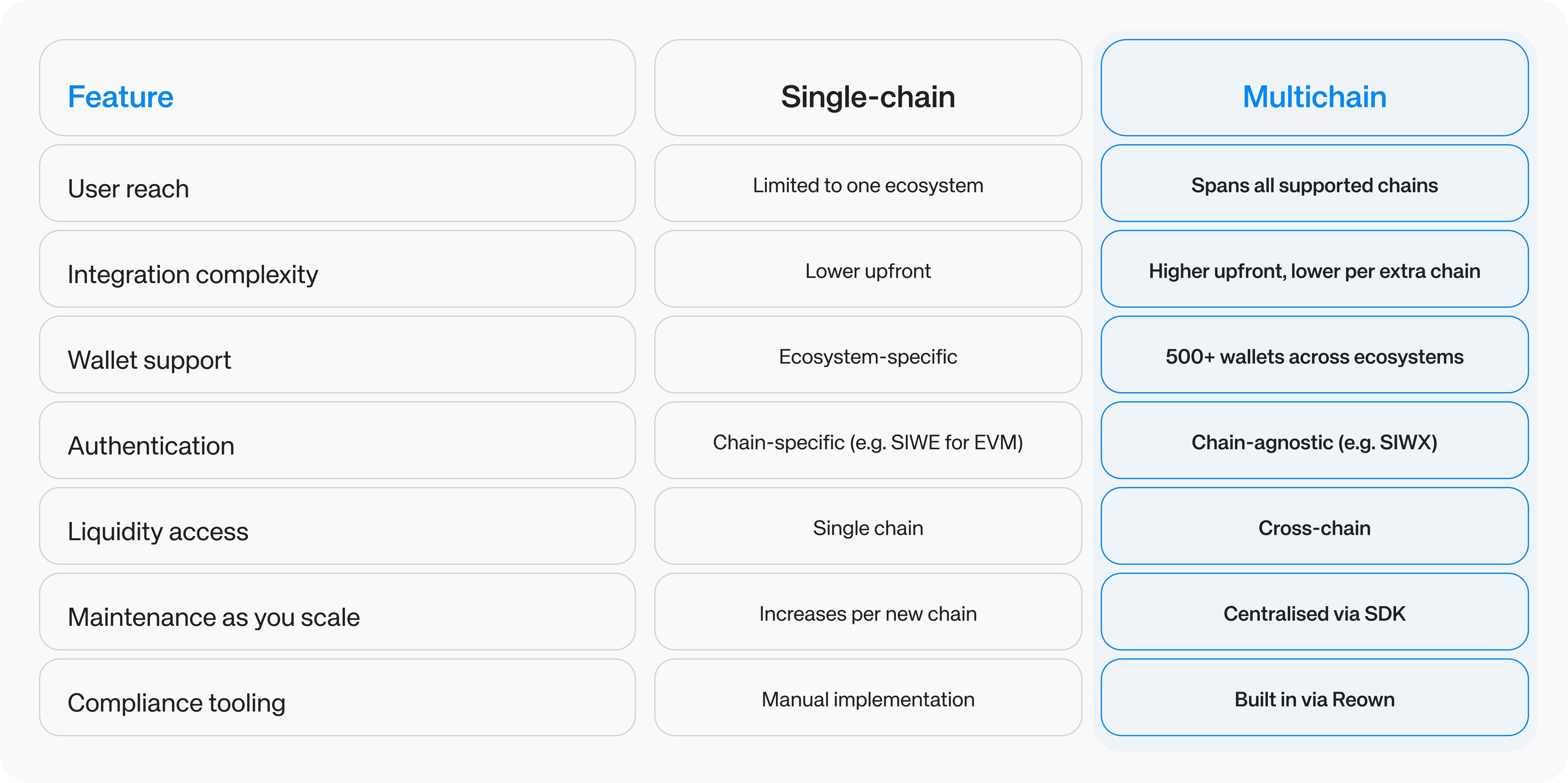
Single-chain development scopes an application to one network — Ethereum, Solana, or Base — and builds authentication, wallet connections, and transactions entirely within that ecosystem. It is simpler to build and test, and appropriate for apps with a well-defined, chain-specific use case and user base.
Multichain development treats the blockchain landscape as a unified environment and builds the application to serve it. The trade-off is additional integration complexity upfront; the return is access to a larger addressable market, no forced migration for users who hold assets on multiple chains, and an architecture that can expand to new networks without structural rebuilding.
Advantages and disadvantages of multichain app development
Advantages
Larger addressable market
Every additional chain your app supports is a new segment of users who can interact with it without friction. EVM alone covers hundreds of networks and millions of wallets; adding Solana, Bitcoin, and Tron extends that reach significantly.
Resilience against ecosystem fragmentation
Apps scoped to a single chain are exposed to the risk that users migrate to another ecosystem. Multichain architecture distributes that risk and ensures the app remains relevant as user behaviour shifts.
Reduced time-to-market for new chain support
With multichain infrastructure in place, adding support for a new chain is a configuration change rather than an engineering project. This dramatically shortens the time between a new network gaining traction and your app being available to its users.
Unified product analytics
Aggregated data across chains gives product teams a more complete picture of user behaviour — which chains drive the most activity, where users drop off, and how onboarding conversion varies by ecosystem.
Disadvantages
Higher initial integration complexity
Building for multiple chains from the start requires more planning around session management, wallet state, and transaction routing than a single-chain implementation. Using an SDK that handles this at the infrastructure level — rather than the application level — significantly reduces this burden, but it does not eliminate it entirely.
Testing across multiple environments
A multichain app must be tested on each supported network's testnet, which multiplies the surface area of QA relative to a single-chain app. Automated testing strategies and SDK-level abstractions help manage this.
Cross-chain UX requires careful design
Presenting a consistent experience to users on different chains requires deliberate UI/UX decisions — how to display wallet types, how to handle network switching, how to surface chain-specific information without confusing users. This is a design challenge as much as an engineering one.
How to start building with multichain development
Step 1: Create your Reown project and get your Project ID
Set up a project in the Reown dashboard to obtain your Project ID. This is required for the Reown SDK to authenticate your app with the WalletConnect network.
Step 2: Install the Reown SDK and configure your supported chains
Add the Reown SDK to your project using your framework's package manager — React, Next.js, Vue, JavaScript, React Native, Flutter, iOS, Android, and Unity are all supported. Configure the chains you want to support. View all supported chains →
Step 3: Enable SIWX authentication
SIWX authentication is enabled by default from Reown SDK v1.5.0 onwards — no additional setup is required. Your app will accept wallet connections from EVM, Solana, Bitcoin, and Tron from the point of first setup.
Step 4: Enable multiwallet linking
Multiwallet linking allows users to connect wallets from multiple chains in a single session and switch between them without leaving your app. Enable it within your SDK configuration to eliminate the most common source of cross-chain drop-off.
Step 5: Add payment and transaction tooling for your use case
Depending on your app type, add the relevant payment features: onramp for funding wallets, swaps for in-app asset exchange, or deposit with exchange for users who hold assets on centralised exchanges.
The future of multichain app development
The direction of the blockchain ecosystem is not towards consolidation around a single chain — it is towards more networks, more ecosystems, and more users distributed across them. Chain abstraction, the next frontier of multichain infrastructure, aims to make the underlying network entirely invisible to the end user, presenting onchain apps as seamlessly as any web app regardless of where their assets sit.
Multichain development is not a feature to add later — it is increasingly the baseline for any application that intends to serve a meaningful share of the onchain user base. The teams that invest in chain-agnostic infrastructure now will spend less time rebuilding as the landscape evolves, and more time serving the users that infrastructure unlocks.
Get started with multichain development in the Reown dashboard →
Further reading: