SIWE vs SIWX Authentication: What's the difference?

Key Takeaways:
- SIWE authenticates EVM users via cryptographically signed messages; SIWX extends that same standard to work across any blockchain ecosystem.
- As apps expand beyond Ethereum, SIWE's single-chain scope forces developers to maintain separate authentication flows — and shuts out non-EVM users entirely.
- Reown SIWX replaces SIWE's single-chain logic with one chain-agnostic integration that covers EVM, Solana, Bitcoin, and Tron from the same connection modal.
For years, Sign-In with Ethereum (SIWE) was the authentication standard for onchain apps. It gave developers a reliable, decentralised way for users to prove wallet ownership without relying on centralised identity providers — a meaningful step forward for the EVM ecosystem. But as the onchain landscape expanded to include Solana, Bitcoin, Tron, and more, the limits of a single-chain standard became a problem developers could no longer work around.
Sign-In with X (SIWX) is the evolution — a chain-agnostic authentication standard built on SIWE's foundations but designed to work across the entire financial internet. Understanding the differences between the two helps developers choose the right approach for where their users actually are.
SIWE vs SIWX: What's the difference?
What is SIWE?
Sign-In with Ethereum (SIWE) was introduced in EIP-4361 in 2021, developed by a digital identity company named Spruce, in collaboration with the Ethereum Name Service (ENS). Its purpose is to let users prove ownership of their on-chain identity using their existing Ethereum wallet keys, reducing dependence on centralised login providers like Google or Auth0. SIWE works by having the app generate a human-readable message, which the user signs with their EVM wallet. The signature is then verified server-side to establish an authenticated session. It became the standard authentication method for EVM-based applications and remains widely used today.
What is SIWX?
Sign-In with X (SIWX) is Reown's multichain evolution of the SIWE standard. Where SIWE is tied to Ethereum and EVM-compatible networks, SIWX follows the CAIP-122 specification — a framework for blockchain-based authorisation that works across different network namespaces. SIWX uses the same message-signing approach as SIWE but abstracts the chain-specific signature logic, so the same authentication flow works whether the user is connecting an EVM wallet, a Solana wallet, a Bitcoin wallet, or a Tron wallet. Since version 1.5.0 of the Reown SDK, existing SIWE implementations are automatically migrated to SIWX, making multichain authentication the default for all developers on the platform.
The core difference
SIWE is an Ethereum-specific standard. SIWX is a chain-agnostic standard built on the same conceptual foundation. Both use signed messages to prove wallet ownership; the difference is scope. SIWE works for one ecosystem. SIWX works for all of them — from a single integration, without requiring separate authentication libraries per chain.
Differences between SIWE and SIWX
Network compatibility
SIWE authenticates users exclusively through EVM-compatible wallets. Any user connecting from Solana, Bitcoin, or Tron is outside its scope, requiring either a separate authentication implementation or exclusion from the app entirely. SIWX natively handles EVM, Solana, Bitcoin, and Tron within a single flow, with no additional libraries needed per chain.
Compliance support
SIWE has no built-in mechanism for regulatory compliance. Apps that need to meet Travel Rule requirements or verify user geography must build or integrate separate tooling on top of a SIWE implementation. SIWX via Reown includes Travel Rule compliance and verification by default, making it possible to meet global regulatory standards without breaking the authentication flow or adding external services.
Session management and analytics
SIWE produces a verified session, but what you do with that session is entirely up to the developer. There is no built-in session management, user history, or analytics. SIWX via Reown integrates with the Reown dashboard, which surfaces session data, user history, and geographic insights as part of the standard authentication setup.
Underlying specification
SIWE is defined by EIP-4361, an Ethereum Improvement Proposal scoped to the Ethereum ecosystem. SIWX follows CAIP-122 — a chain-agnostic account identifier standard that is not tied to any single network. This makes SIWX more future-proof: as new chains emerge, the same specification accommodates them.
Backwards compatibility
SIWX is backwards compatible with SIWE. Developers already using Reown's SIWE configuration do not need to rewrite their implementation — the Reown SDK maps existing SIWE settings to SIWX automatically. The migration path is designed to be non-breaking.
SIWE vs SIWX: The impact for app developers
Integration complexity
A SIWE integration is scoped to EVM, which keeps its surface area small. The trade-off is that any expansion beyond EVM requires building and maintaining separate authentication logic per chain. SIWX replaces that with one integration. The Reown SDK handles the differences between chain signature formats — EVM, Solana, Bitcoin — so developers do not need to implement chain-specific message generation or verification independently.
Security model
Both SIWE and SIWX use the same core security mechanism: a cryptographically signed message that proves wallet ownership without transmitting private keys. SIWX extends this to non-EVM chains while preserving the same security properties. Both standards include nonces in generated messages to prevent replay attacks. For teams handling regulated financial activity, SIWX's built-in compliance tooling reduces the risk of gaps in regulatory coverage.
UX implications
With SIWE, a user connecting from a non-EVM wallet hits a dead end or encounters a different authentication path — friction that leads to drop-off. SIWX presents users with a consistent experience regardless of their wallet or chain. From the user's perspective, the login modal works the same way whether they are on Ethereum or Solana, which reduces confusion and abandonment during onboarding.
Developer ecosystem and tooling
SIWE has a mature ecosystem with established libraries and documentation, which is an advantage for teams already building within EVM. SIWX is supported directly through the Reown SDK, which provides built-in utilities for message generation (SIWXMessenger), signature validation (SIWXVerifier), and session management (SIWXStorage). Each component can be customised or replaced to fit existing backend infrastructure.
SIWE vs SIWX: Comparison
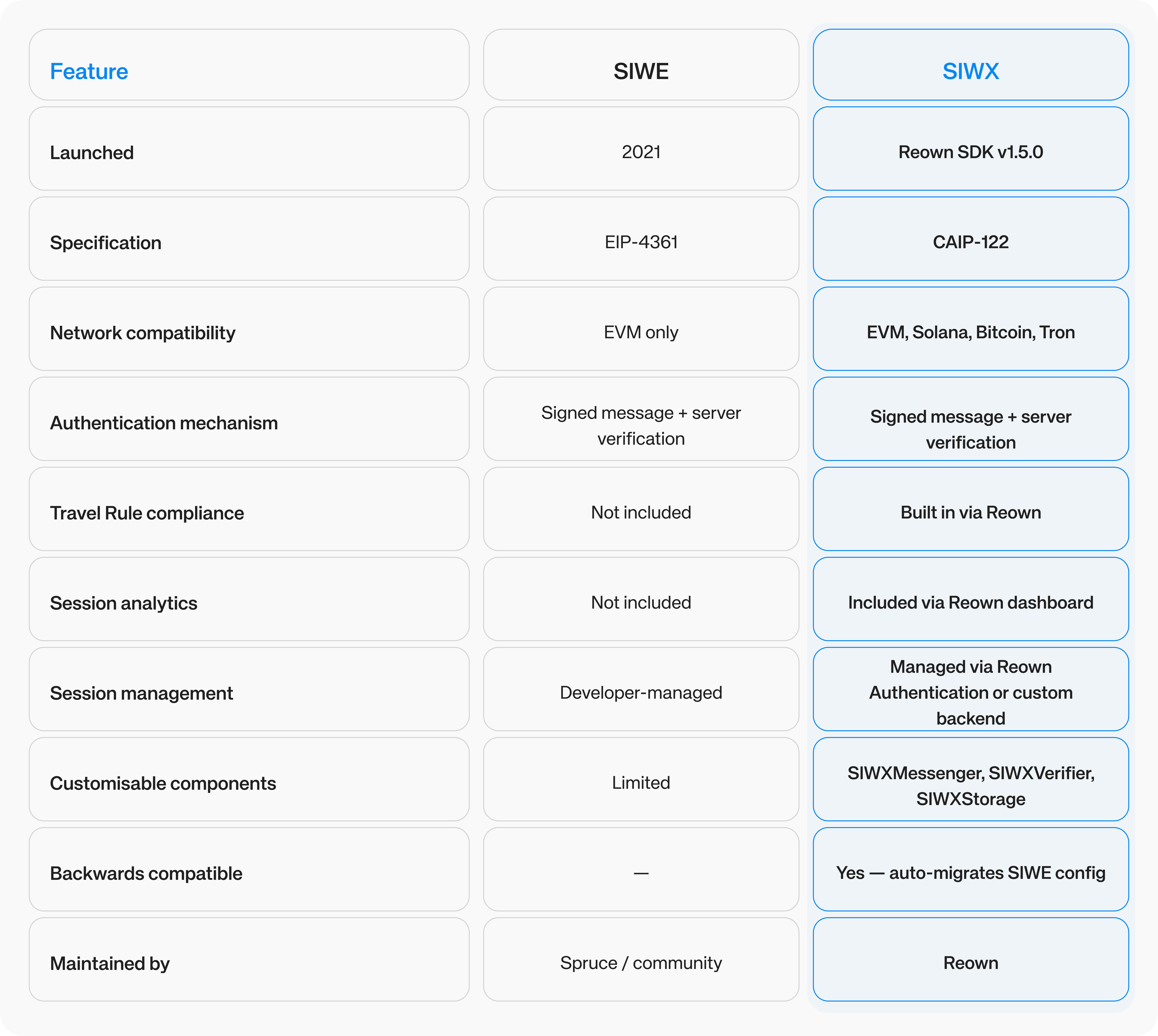
Which apps are more suited to SIWE vs SIWX?
Apps better suited to SIWE
SIWE remains a practical choice for apps that are strictly EVM-native and have no plans to expand beyond the Ethereum ecosystem. If your user base exclusively uses EVM wallets, SIWE's maturity and broad library support make it a stable option. It is also still supported via Reown — developers who want to keep a SIWE flow for EVM-specific use cases can do so using One-Click Auth, which provides a streamlined SIWE implementation within the Reown SDK.
Apps better suited to SIWX
SIWX is the right choice for any app targeting users beyond the EVM ecosystem, building on Solana, Bitcoin, or Tron, or planning to support multiple chains in the future. It is also the better choice for teams that need compliance features built into their authentication layer, rather than added on later. This includes DeFi platforms, fintech apps, enterprise and institutional tools, and any consumer product where cross-chain wallet support is part of the user experience.
The future of SIWE and SIWX
SIWE established an important precedent — decentralised, cryptographic authentication that does not depend on centralised identity providers. That foundation remains sound, and the standard continues to see use within the EVM ecosystem.
SIWX is where that foundation is going. As more users hold assets and interact with apps across Ethereum, Solana, Bitcoin, and beyond, a single-chain authentication standard becomes an increasingly narrow solution. SIWX is designed for the multichain reality that already exists — one integration, consistent UX, built-in compliance, and session insights across all supported chains.
For teams building with Reown, SIWX is the default from SDK v1.5.0 onwards. If you are starting a new project, or looking to extend an existing SIWE integration to new chains, SIWX is the path forward.
Get started with SIWX in the Reown dashboard →
Further reading: