Sign-In with X (SIWX) vs SIWE: What’s the difference?
For years, wallet-based authentication was purely focused on the Ethereum ecosystem. Signing in to multiple networks across the EVM ecosystem was already a big step forward after dealing with siloed networks. To manage sign ins across the whole EVM network, with its huge variety of wallets, developers relied on an authentication standard called Sign-In with Ethereum (SIWE). But today, it’s not the only authentication method out there, and arguably, not the best solution either.
But before we dive into that, let’s explore what SIWE is and some of the challenges it poses for apps today.
What is Sign in with Ethereum (SIWE) ?
Sign in with Ethereum was introduced in EIP-4361 and launched in 2021. It was developed by Spruce, a digital identity company, in collaboration with the Ethereum name service. Its purpose is simple: to allow users to prove ownership of their off-chain identity using their on-chain keys. The idea was to reduce reliance on centralized identity providers, and such, saw huge adoption across the decentralized EVM ecosystem, becoming the flagship authentication method for all Ethereum ecosystem users.
Challenges of using SIWE
As the digital finance landscape has expanded to include high-growth ecosystems like Solana and Bitcoin, the limitations of a single-chain authentication standard have become a bottleneck for builders.
Fragmentation in the login experience creates friction. A user with a Solana wallet shouldn't have to navigate a different authentication logic than a user with an EVM wallet. Developers need a unified way to handle decentralized identity that scales across the entire financial internet.
The Solution: An Evolved, Multichain Authentication Method
While SIWE represented a huge jump in decentralized and flexible authentication, as mentioned, today it’s still not flexible enough to serve the diverse blockchain ecosystem in 2026. This is why Reown designed Sign-In with X (SIWX)—a chain-agnostic authentication solution designed to facilitate decentralized authentication across multiple networks.
What is Reown Sign-In with X (SIWX)?
Reown SIWX is the next generation of wallet-based authentication. While it builds on the foundations of the Sign-In with Ethereum (SIWE) standard, it is designed to be completely chain-agnostic. SIWX follows the CAIP-122 standard, which establishes a framework for blockchain-based authorization that works across different namespaces.
In practice, SIWX allows onchain applications to authenticate users by having them sign a unique, human-readable string message with their blockchain wallets—regardless of whether that wallet is on Ethereum, Solana, Bitcoin, or Tron. Since version 1.5.0 of the Reown SDK, SIWE implementations are automatically migrated to SIWX, ensuring that multichain support is the default for all builders using the platform.
SIWX vs SIWE: What's the difference?
Authentication is the front door of any onchain finance experience. If that door only opens for one type of user, you are limiting your growth. SIWX is critical because it solves several key challenges for modern development teams:
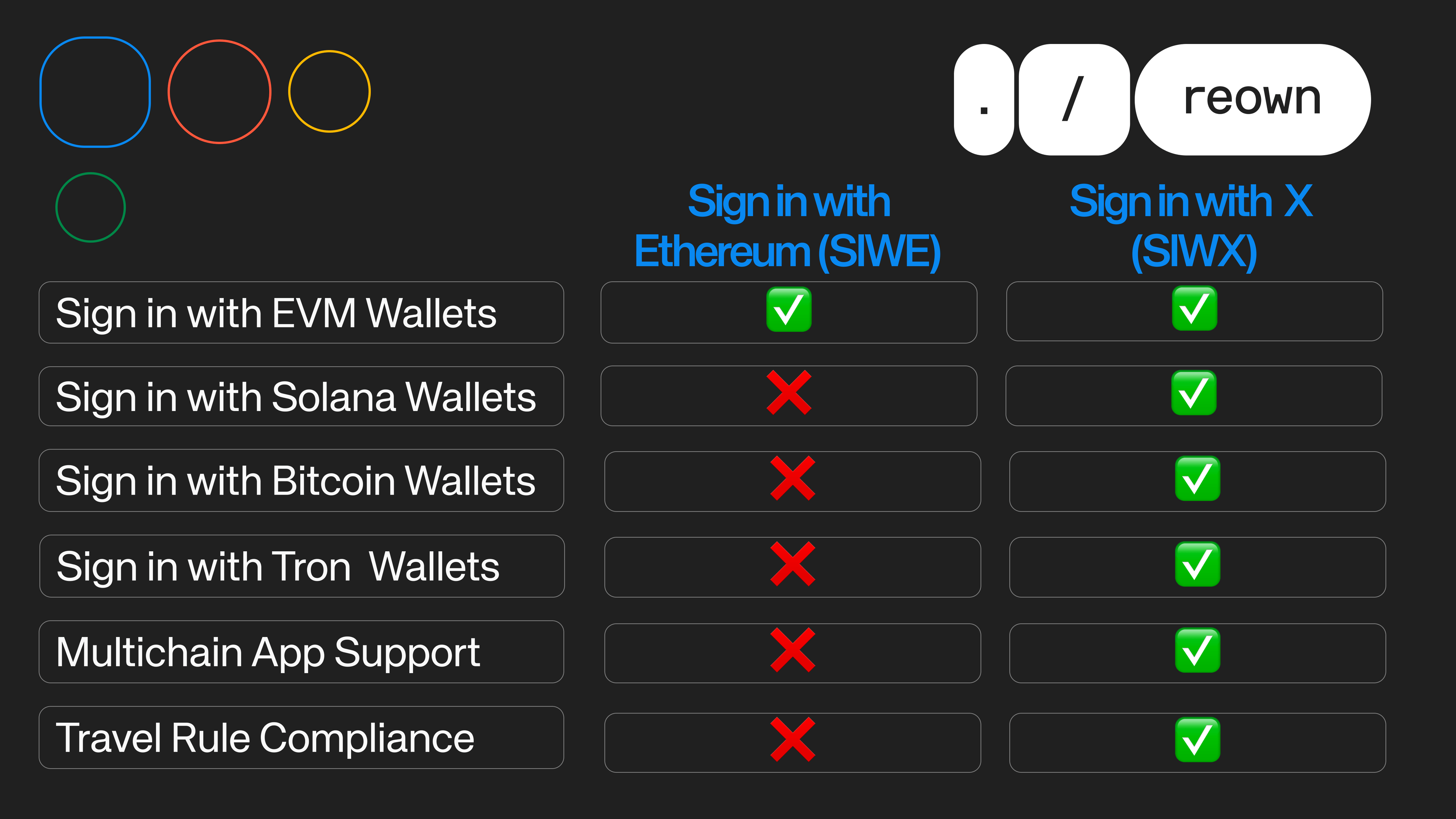
- Multichain Interoperability: Unlike SIWE, which is restricted to EVM wallets, SIWX provides a single integration that supports EVM, Solana, Bitcoin, and Tron. This prevents ecosystem fragmentation and allows you to reach a broader audience.
- Built-in Compliance: For institutional and enterprise builders, SIWX facilitates Travel Rule compliance and verification, unlike SIWE. This allows apps to meet global regulatory standards without breaking the user experience.
Who is SIWX for?
SIWX is designed for growth-driven teams building onchain finance. This includes:
- Multichain App Builders: Developers who want to offer a consistent login experience across different ecosystems like Ethereum and Solana without maintaining multiple authentication libraries.
- DeFi and Fintech Platforms: Teams that require secure, session-based authentication for sensitive financial operations while benefiting from built-in compliance features.
- Enterprise and Institutional Teams: Organizations that need to launch secure, compliant offerings that integrate with existing identity management systems.
- Web3 Social and Gaming Apps: Builders who need frictionless onboarding—such as one-click login—to keep users engaged in high-velocity environments.
How does Reown SIWX work?
SIWX can be enabled via a toggle in the Reown dashboard. Once enabled, you can get started with your authentication flows, which typically follow these steps:
- Message Generation: When a user attempts to log in, the dApp generates a cryptographic message. This message includes the domain, the user's address, a unique nonce to prevent replay attacks, and other metadata.
- Signature Request: The user is prompted to sign this message with their wallet. With One-Click Auth, this happens as part of the initial connection request.
- Verification: The signature is sent to a verification server (either your own backend or the Reown Authentication service). The server checks the signature against the wallet address and the expected message content.
- Session Issuance: Once validated, a session (such as a JWT token) is issued. If you use Reown Authentication, these sessions are managed through the Reown Dashboard, giving you visibility into user history and geographic insights.
The framework is divided into three core components that can be customized: the SIWXMessenger (for message generation), the SIWXVerifier (for signature validation), and the SIWXStorage (for session management).
How to integrate Reown SIWX
Integrating SIWX is designed to be developer-first and benefit-led. Most teams can get up and running by simply adding a few lines to their AppKit configuration.
1. Initialize the Plugin
The recommended way to implement SIWX is using Reown Authentication (formerly CloudAuthSIWX). This handles message generation and session management out of the box.
2. Manage Sessions
You can use the useAppKitSIWX hook to interact with the authentication state, retrieve user information, or manually sign out users when they disconnect.
3. Customize Your Flow
If you have specific backend requirements, you can extend the DefaultSIWX class to provide your own messenger or verifier logic. This allows you to tailor the message format or session storage to your existing infrastructure.
For full technical details, refer to the Reown SIWX Documentation.
SIWX: Unlocking Seamless Multichain UX
By moving beyond the limitations of SIWE, SIWX enables developers to build apps that are truly chain-agnostic. It eliminates the need for users to switch mindsets (or apps) when moving between different blockchains.
With SIWX, you aren't just adding a login button; you are implementing a secure, compliant, and insight-rich infrastructure that powers growth-driven onchain finance. Whether you are building a DeFi protocol on Solana or an enterprise solution on Bitcoin, SIWX provides the tools to ship faster and scale better.
SIWX FAQ
Q: Is SIWX backwards compatible with SIWE?
Yes. If you are already using Reown’s SIWE configuration, AppKit automatically maps those settings to SIWX. You can continue to use your existing logic while gaining the ability to expand into other chains.
Q: Which chains are supported by SIWX?
SIWX currently supports EVM-compatible chains, Solana, Bitcoin, and Tron. It is designed to be the universal standard for authentication across the financial internet.
Q: Do I need a backend to use SIWX?
To verify signatures and manage sessions securely, a backend is required. You can either use your own backend or leverage Reown Authentication, which provides a managed cloud service to handle verification and session management for you.
Ready to build? Head to the Reown Dashboard to start integrating SIWX today.