UX Writing in the Age of AI; when and where human input matters
The rise of AI has been a crucial turning point for most tech businesses. It has made the first draft of anything low-cost and instant. That’s a blessing for many businesses, if used with restraint. However, today, many product teams struggle with where to draw the line.
For most of software's history, UX copy was a task left for the finishing line: the flow got built, the screens got designed, and only then would someone fill in the labels, button copy, error messages and so on.
That order has always been a mistake. But with the adoption of AI, this approach has only increased; when a tool can produce purpose-built copy in seconds, the instinct is to hand it the entire job.
While many have decided that approaching UX copy like that will suffice, Reown has gone in another direction. Instead, we believe that a truly useful UX can be supported by AI, without being entirely handed off to it.
So you might be wondering, why choose this approach? And what parts of UX copy can AI actually assist with?
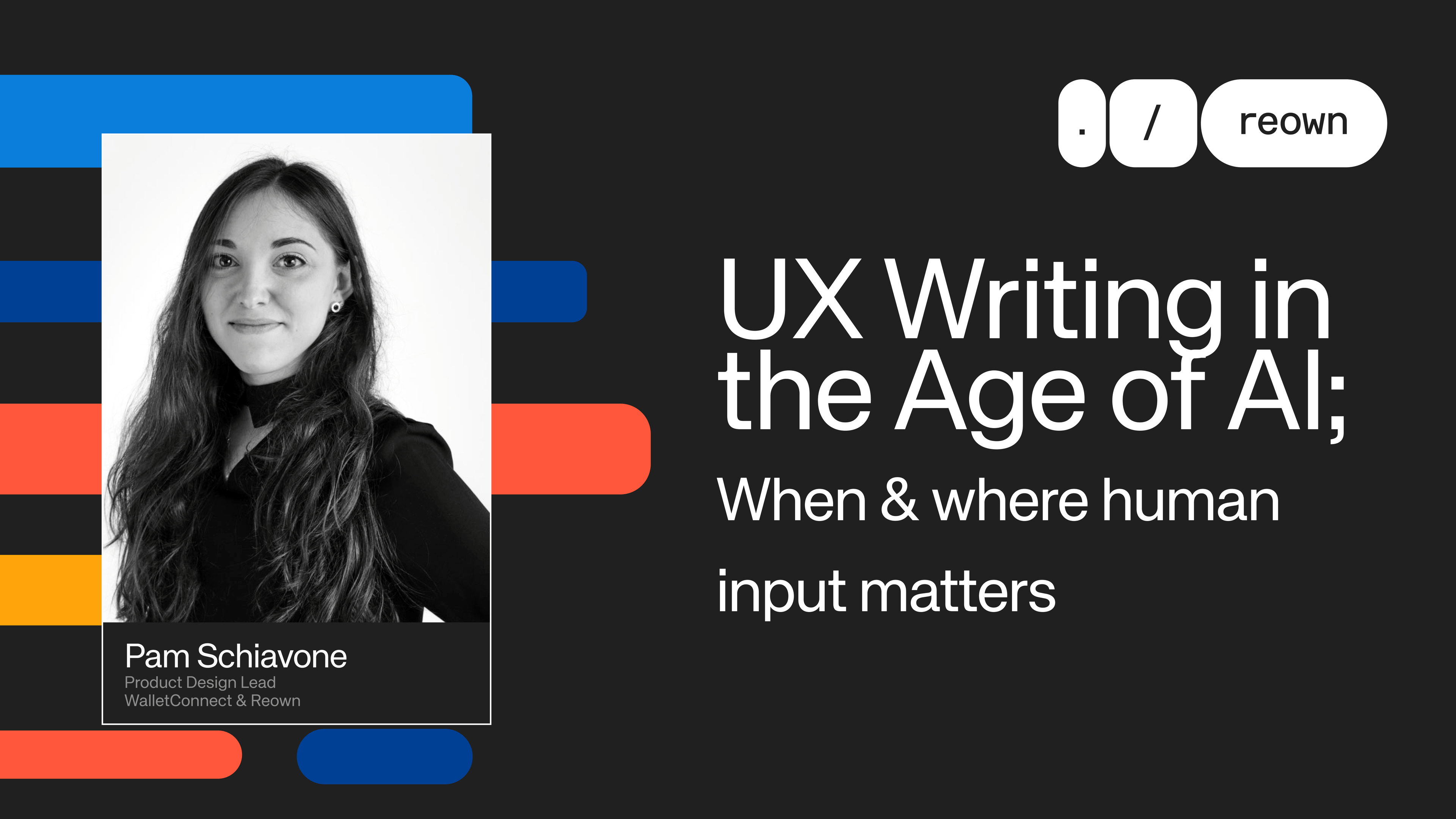
To answer those questions, Reown’s product Marketing manager Jem sat down with Pam Schiavone, WalletConnect’s lead product designer who joined the team in March 2026.
Together, they explored her 14 years of experience in product design, from her start in graphic design, to her expansion into UX writing, to leveraging her skills and processes to shape the way Reown approaches UX.
14 years of product design experience joins the Reown team
Pam’s entry into the product design world started in graphic design; the origin of what sparked her curiosity into branding and visual identity.
According to Pam, Aaron Walter’s book “Designing for emotion” introduced her to the idea of treating a product as a person with its own character rather than just a color palette and a logo; and this fundamentally changed the way she saw brand and product.
“ What clicked for me was that this personality isn't only an abstract brand layer, it gets real through concrete decisions: the voice, yes… but also the visual design, the copy, and the interactions, all expressing that same character.
You define that personality once, and it tells you how the product should speak, look, and respond at every touchpoint. That reframed everything for me. I understood that identity lives in how a product behaves and sounds, not only in how it looks.”
UX Writing and brand voice; complementary, not competing.
What’s important to note is that brand voice is completely distinct from UX writing; a fact often misunderstood. UX writing is not narrative-driven. It’s not marketing copy. And it can’t simply be a display of brand personality either. Instead, UX writing is the functional language inside a product. It's the labels, the errors, the empty states, the confirmations; the words that help a person understand what's happening and what to do next.
Pam argues that both brand voice and UX writing need to work together to build a truly seamless experience;
“UX writing's first job is clarity and getting the user through the task. Voice and tone is the personality layer that rides on top. Software that responds in a robotic way feels cold even when the flow technically works.”
As an example of how that works in practice, she mentioned Airbnb’s booking confirmation message reading ‘You’re going to New York; instead of ‘Your reservation has been confirmed’.
"It was voice and tone serving the experience, not decorating it. That was a small Eureka moment for me!”, she added.
Building good UX copy beyond the brand
Pam touched on the ingredients she believes make for an optimal user experience;
"Good UX respects the user's time and attention instead of asking for more of it. At every step the user should know three things: what's happening, what to do next, and what happens if they do it. If any of those is confusing, the design isn't doing its job — it's pushing the work onto the user."
For any builder, attention to detail is important: every extra moment your users have to spend trying to understand your UX is detracting from your potential to engage them. And in 2026, retaining and engaging users is more important than ever.
Of course, creating great UX copy stretches further than just balancing both function and personality. Specifically in the emerging tech and digital asset space, Pam brought up the importance of trust;
"People need to feel safe before they understand anything else because there's real money on the line."
Trust is necessary to engage users and make them feel supported. You can have the best product in the world, but if it doesn’t behave as it should, or notify the user effectively, it will automatically diminish trust in your product. This was one of the core challenges Pam wanted to address when incorporating AI into our UX writing flows.
AI and UX writing: The Potential Benefits vs the Potential Dangers
In the rush to automate, it can be easy to skip some of the most important questions, such as what is AI actually good at, and what should stay with a person?
That’s why although Reown leverages AI to reduce time until production, it was not chosen to simply generate UX copy. On the dangers of choosing an AI-first approach, Pam warned:
"The dangerous part is that plausible but wrong copy now ships at scale”
You may have noticed that exact issue in many of the platforms you use today; incorrect answers pulled from irrelevant web pages, confusing language, or generic instructions that seem unrelated to the platform you’re using. This is a direct effect of choosing to delegate all UX copy to AI to save time and effort.
But Pam says that mass produced incorrect copy is actually the tip of the iceberg when it comes to challenges;
"It doesn't know your product, your terminology, and has no idea what the user has at stake at that specific step," she warns. "It reads fine but it's often inaccurate for your product or feature and it quietly erases the product's voice. Everything converges into a generic tone—that over-helpful AI voice. For a product trying to feel distinctive and reliable, that's a real cost."
The truth is, AI generated UX copy can negatively impact your entire brand’s image and trustworthiness in the eyes of its users. After all, what’s the point of curating a brand identity, if you don’t respect it all the way down to the UX?
How to Leverage AI for UX copy more purposefully
With the very tangible risks involved, at Reown, we wanted to tackle UX writing with a more purposeful, user-centric approach; one that valued our team’s skills and expertise while still leveraging AI to cut down time and overall costs.
The mission was simple, and Pam made the direction clear; understanding AI could be a support tool rather than a hard replacement for human intellect;
"Use it to set a standard, not to replace judgment," Pam says. "The best use is as a second opinion or pair of eyes based on your own rules: your guidelines, your glossary, your decisions. It makes the team's tacit knowledge explicit and applies it the same way every time, regardless of who's reviewing."
If the standard is set by the experts with years of experience under their belts, then the highest-leverage thing AI can do is enforce that standard. And that’s exactly the thought process behind Pam’s UX copy Audit Skill which leverages her wealth of knowledge to provide instant and trustworthy checks without relying on it completely.
The process starts with human-written UX copy, built for its specific purpose. Then, this copy is handed to an AI skill trained on our brand voice and UX copy guidelines: context built using Pam’s experience. Finally, the copy is checked by a small team of reviewers familiar with Reown and WalletConnect’s brand and products.
By leveraging AI alongside human writers and reviewers, it effortlessly balances functionality and personality. This removes the worry that our tone of voice could become the same as every other platform.
"It gives the whole company a way to check UX copy is aligned with the brand voice, the UX rules, and the patterns we've defined," Pam says. "The skill audits the copy against the guidelines and hands back a rewrite that's ready to apply."
Despite the AI providing an audit of the copy, it’s not a final reviewer either. It’s just a part of a bigger process ensuring UX copy is as purpose-built and brand aligned as possible.
“Anything that ships still passes through a small reviewers team. The owner doesn't write everything — they make sure everything that ships meets the bar, and the proposals that reach them now arrive with better quality and criteria upfront," she added.
By including human reviewers before shipping, we ensure that copy is accurate and still keeps the essence of the brand; that the AI isn’t correcting language that doesn’t need to be corrected or changing the meaning of something it didn’t intend to.
"If we'd let AI just write and ship the copy, we'd lose that layer and take the designer and writer out of the loop. So the skill enforces the standard and hands you a solid draft, but the person owns the judgment," Pam explained.
The underlying model is portable: democratize the draft, own the review. It’s a process that ensures consistency without removing heart, soul or over 14 years of experience.
What production taught the team
A few weeks of real use surfaced lessons that matter for anyone considering the same approach. The first impact was cultural rather than metric, and it's the one Pam cares about most.
"The whole team, the whole company, now understands that this matters — that what we put in the copy is not trivial, it's a delicate decision," she says. "We're seeing real adoption and real commitment to taking care of this layer, the same way you'd care about using the right colors or the right assets from the design library. Copy stopped being the thing you fill in at the end."
The second is visibility: every audit ends with a ready-to-paste handoff for a shared channel.
"The review doesn't die in a DM," she says. "All of us can show what's actively being worked on, and sharing those cases out in the open makes everyone learn from each other's examples."
The third building a standardization that can be iterated upon;
"It turned an ad hoc process into a standardized one. And in three weeks of real use it surfaced things to improve in the skill itself, such as what to add to the guidelines. What’s for certain is that it made one thing very clear: if we want an optimal result, we still need the human eye and human work. UX writing is not something we can do 100% with AI."
Where it goes next and what stays human
The key benefit is that the principles to write UX copy shouldn’t change as AI is incorporated into daily tasks. AI can help a whole team keep the standard, but the initial writing and the final decisions stay with people.
"Copy is the voice of our product. It opens a conversation," Pam says. "Just as AI can pull information for a research study in seconds, nothing replaces what we catch with our own eyes — the pauses we register in a one-on-one interview, the questions that come to mind in the moment and weren't listed in the script. There's a part of the copy that has to stay as human a conversation as possible. And that part is not something you hand off to an AI. It's trained, and more importantly, it's cared for."
That's the real lesson of the shift. The standard can be automated. The judgment and the conversation can't.
Leveraging Reown’s Approach to UX copy in your own app
For anyone building early stage start ups that don’t know how to approach UX copy, the best thing is that our approach is accessible: it can be adopted by any team.
To help you, we’ve built 6 tenets of creating meaningful UX copy;
- Start with the personality, not the screens. Decide who the product is before designing anything. Think about how it sounds, how it behaves, what it would never say. Every later decision then has something to measure against. Without it, everyone improvises and you end up with five products wearing the same logo.
- Give the user context. At every step they should know what's happening, what to do next, and what happens if they act. And don’t forget trust if money or anything sensitive is involved. You don't need a research budget to check it: sit next to five people while they use it.
- Write the copy with the design, not after it. Copy is the thing that exposes where a flow isn't clear. If you can't write the screen in a few honest words, the screen isn't finished.
- Understand what "simple" really means. Simple doesn’t mean cutting down the copy or removing screens, it means doing the hard work of deciding for the user so they don't have to carry that burden.
- Start a tiny glossary before you think you need one. One word, one meaning, used everywhere. It's painful to untangle once you've scaled and the same concept has three different names.
- Don't copy a pattern just because the big products use it. Much of what looks like "the standard" is inherited; often a technical constraint everyone is repeating. The advantage of starting fresh is that you don't carry that baggage.
Now you’re ready to build a world-class UX!